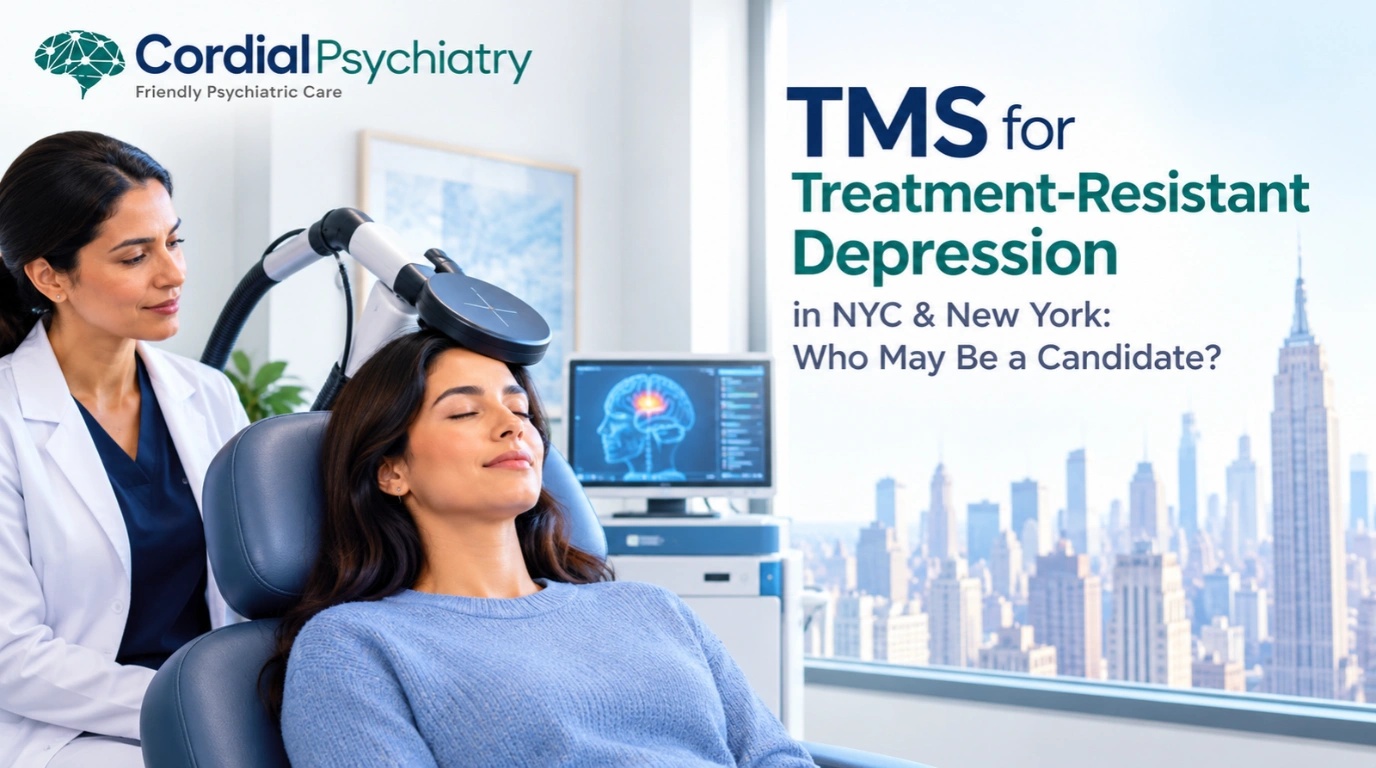
TMS for Treatment-Resistant Depression in NYC & New York: Who May Be a Candidate?
Living with depression can be exhausting, especially when you have already tried medication, therapy or both and still do not feel like yourself. For some patients, depression symptoms continue even after sincere effort, consistent treatment and multiple care adjustments. When that happens, it may be time to ask whether TMS for treatment-resistant depression could be an appropriate next step.
At Cordial Psychiatry, we provide TMS therapy in Yonkers, NY for patients who may benefit from a non-invasive treatment option for depression. People searching for TMS treatment NYC, TMS therapy New York, TMS for depression NYC or TMS treatment near me often want the same answers: Am I a candidate? What does treatment involve? Is it safe? How do I know if it is right for me?
This guide explains what treatment-resistant depression means, when TMS may be considered, what the evaluation process involves and why eligibility is always determined individually.
What Treatment-Resistant Depression Means
Treatment-resistant depression does not mean that your depression is impossible to treat. It usually means that symptoms have not improved enough after appropriate treatment attempts, such as antidepressant medication, psychotherapy or a combination of both.
Many clinicians and insurance plans look at whether a patient has tried one or more adequate courses of medication before considering TMS. However, every case is different. The type of depression, severity of symptoms, medication history, side effects, medical background and personal goals all matter.
Depression itself can affect mood, sleep, appetite, concentration, energy, motivation and daily functioning. The National Institute of Mental Health explains that depression can interfere with how a person feels, thinks and handles daily activities. That is why continued symptoms should be taken seriously, even if someone appears to be functioning on the outside.
If you have tried to “push through” depression and still feel stuck, you are not alone. Treatment-resistant depression is a clinical situation that deserves a thoughtful psychiatric evaluation, not judgment.
What TMS Is
TMS stands for Transcranial Magnetic Stimulation. It is a non-invasive brain stimulation treatment that uses magnetic pulses to stimulate areas of the brain involved in mood regulation. During treatment, a magnetic coil is placed against the scalp while the patient remains awake.
According to the Mayo Clinic, TMS uses magnetic fields to stimulate nerve cells in the brain and is sometimes used when other depression treatments have not been effective. The treatment does not require surgery, implanted electrodes or anesthesia.
For many patients exploring Transcranial Magnetic Stimulation NYC or TMS New York, one of the most important benefits is that TMS is not a daily medication. It is performed during scheduled outpatient appointments and is typically considered as part of a broader depression care plan.
When TMS May Be Considered
TMS may be considered when depression symptoms continue despite previous treatment. This may include people who have tried antidepressant medication but did not get enough relief, experienced difficult side effects or needed another option after therapy and medication did not fully help.
It may also be discussed when symptoms keep returning or when depression is affecting work, relationships, school, sleep, motivation or the ability to enjoy life. Some patients ask about TMS because they want a treatment that does not involve increasing medication dosage. Others are referred after several treatment adjustments.
TMS is not a first step for every patient, and it is not a shortcut around proper diagnosis. Before beginning TMS, a psychiatric provider should confirm that the symptoms, history and safety profile support this treatment option.
At Cordial Psychiatry, we evaluate each patient’s needs carefully before recommending TMS therapy. The goal is not simply to offer a treatment. The goal is to understand whether that treatment makes clinical sense for the person sitting in front of us.
Who May Be a Candidate?
A potential candidate for TMS is often someone with depression that has not responded well enough to standard treatment. However, candidacy depends on several factors.
Persistent Depression
Patients may be considered for TMS if they continue to experience symptoms such as low mood, loss of interest, fatigue, poor concentration, sleep changes, appetite changes, hopelessness or reduced functioning.
These symptoms may remain even after medication, therapy or lifestyle changes. The key question is not whether someone has tried hard enough. The question is whether their current treatment plan is producing enough improvement.
Prior Treatment History
A psychiatric evaluation will usually review past and current treatments. This may include antidepressants, therapy, medication doses, length of treatment, side effects and reasons for stopping or changing treatment.
This step matters because TMS for treatment-resistant depression is often considered after previous treatment attempts have not provided adequate relief. Insurance requirements may also depend on documentation of prior treatments, although coverage rules vary by plan.
If medication is still part of your treatment plan, Cordial Psychiatry also provides medication management services in NYC and New York to support safer prescribing, monitoring and treatment adjustments.
Safety Factors
TMS is generally well tolerated, but it is not appropriate for everyone. A provider will ask about seizure history, bipolar disorder, implanted medical devices, metal near the head, neurological conditions and other safety considerations.
Some patients may need additional review before TMS is recommended. Others may be guided toward a different treatment option if TMS is not the safest fit.
Practical Fit
TMS usually requires multiple outpatient appointments over a course of treatment. Because of that, scheduling, transportation and consistency matter.
Patients searching for TMS treatment near me are often looking for a location they can realistically attend. Cordial Psychiatry is located at 955 Yonkers Ave, Suite 102, Yonkers, NY 10704, which may be convenient for patients in Yonkers, Westchester County, the Bronx, NYC-area communities and nearby parts of New York.
Personal Goals
Treatment planning should include more than symptom checklists. A good evaluation should also ask what the patient wants to improve.
For one person, the goal may be returning to work with more stability. For another, it may be sleeping better, reconnecting with family or feeling less emotionally numb. TMS candidacy should be considered in the context of the patient’s real life.
Who May Not Be a Candidate?
Some patients may not be appropriate candidates for TMS, or may need further evaluation before treatment can be considered.
This can include people with certain implanted devices, metal objects near the head, a history of seizures or medical conditions that increase seizure risk. Patients with bipolar disorder, past manic symptoms, psychosis, severe substance use concerns or urgent safety needs may require a different or more stabilized treatment approach first.
TMS is also not an emergency treatment. If someone is in immediate danger, having thoughts of suicide or may harm themselves or someone else, they should call or text 988 in the United States or go to the nearest emergency room.
The safest answer is always individual evaluation. A person should not assume they are eligible or ineligible based only on an article, online quiz or keyword search.
What Evaluation Involves
A TMS evaluation is designed to answer one main question: Is this treatment clinically appropriate and safe for this patient?
The process may include a review of depression symptoms, psychiatric history, medical history, medications, previous treatment attempts, therapy history, family history and current functioning. The provider may ask about anxiety, trauma, sleep, attention, substance use, mood swings and past manic or hypomanic symptoms.
This is important because depression-like symptoms can have different causes. For example, bipolar depression, grief, trauma-related symptoms, ADHD, substance use, thyroid problems and sleep disorders can all affect mood and energy. A careful evaluation helps avoid treating the wrong problem in the wrong way.
The evaluation may also include discussion of expectations. TMS may help some patients, but it is not a guaranteed cure. It should be explained clearly, including potential benefits, risks, alternatives and the role of ongoing care.
What Treatment Looks Like
During a TMS session, the patient sits in a treatment chair while a device delivers magnetic pulses through a coil placed near the scalp. The patient remains awake and alert. No anesthesia is required.
Some people feel tapping or pulsing sensations on the scalp during treatment. Others may notice mild discomfort at first as they adjust to the sensation. Many patients are able to return to normal daily activities after appointments, depending on how they feel and what their provider recommends.
A full course of TMS is usually delivered through repeated outpatient sessions. The exact schedule, number of visits and treatment approach should be determined by the treating provider.
For patients comparing TMS treatment NYC, TMS therapy New York and other local options, it is important to ask what the treatment process includes, who supervises care and how progress will be monitored.
Side Effects and Risks
TMS is non-invasive, but it can still have side effects. Common side effects may include headache, scalp discomfort, tingling, facial twitching or temporary lightheadedness. These effects are often mild, but patients should always report symptoms to their care team.
A rare but serious risk is seizure. This is one reason a careful safety screening is important before treatment begins. A provider should review personal and family medical history, medications and any factors that may increase risk.
Responsible TMS care should never make exaggerated promises. The best approach is honest, patient-centered and clear about both benefits and limitations.
Why Individual Eligibility Matters
It can be tempting to search “TMS for depression NYC” and look for a simple yes or no answer. But mental health care is more personal than that.
Two people may both have depression, but very different histories. One may have tried several medications with side effects. Another may have undiagnosed bipolar disorder. One may be medically appropriate for TMS, while another may need a different treatment plan first.
Eligibility also depends on current symptoms, diagnosis, treatment history, safety factors, insurance documentation and patient preferences. That is why Cordial Psychiatry focuses on individualized care rather than one-size-fits-all recommendations.
TMS in NYC and New York
Patients looking for TMS treatment NYC, Transcranial Magnetic Stimulation NYC or TMS New York often want care that is accessible, professional and connected to a broader psychiatric treatment plan.
Cordial Psychiatry provides TMS therapy at its Yonkers, NY location. The practice also offers psychiatric evaluations, medication management and therapy-focused support, which can be helpful for patients who need more than a single treatment option.
For patients in Yonkers, Westchester County, the Bronx, nearby NYC communities and across New York, Cordial Psychiatry can help determine whether TMS may be appropriate as part of a personalized depression treatment plan.
Questions to Ask
Before starting TMS, patients may want to ask:
- Am I being evaluated for the right diagnosis?
- Have my past treatments been reviewed clearly?
- Why might TMS be appropriate for my depression?
- What risks or side effects should I understand?
- Are there reasons TMS may not be right for me?
- How will my progress be tracked?
- Should I continue medication or therapy during treatment?
- What documentation may my insurance require?
- What should I do if symptoms worsen?
These questions can help patients feel more informed and involved in their care.
Final Thoughts
If depression has not improved enough with medication, therapy or previous treatment attempts, TMS may be worth discussing with a qualified psychiatric provider. It is non-invasive, outpatient and designed for patients whose depression needs another treatment approach.
Still, TMS is not right for everyone. The most important step is a proper evaluation that looks at your diagnosis, treatment history, safety factors, goals and overall mental health needs.
Cordial Psychiatry offers TMS therapy in Yonkers, New York for patients seeking thoughtful, individualized depression care. If you are searching for TMS for treatment-resistant depression, TMS treatment near me or TMS therapy New York, our team can help you understand whether TMS may be a good fit.
To learn more or schedule a consultation, contact Cordial Psychiatry at (914) 570-9000 or visit our TMS therapy page.
FAQs
Is TMS used for treatment-resistant depression?
Yes. TMS is commonly considered for patients with depression that has not improved enough after other treatments, such as medication or psychotherapy. A psychiatric evaluation is needed to decide whether it is appropriate.
Is TMS the same as medication?
No. TMS is not a medication. It uses magnetic pulses to stimulate brain areas involved in mood regulation. Some patients may continue medication or therapy during TMS, depending on their treatment plan.
Does TMS require anesthesia?
No. TMS does not require anesthesia. Patients remain awake during treatment and can usually return to regular activities afterward, depending on how they feel.
Is TMS painful?
Some patients feel tapping, pulsing or scalp discomfort during treatment. Side effects may include headache or mild discomfort. Patients should tell their provider about any symptoms during or after treatment.
Can TMS help if antidepressants did not work?
TMS may be considered when antidepressants have not provided enough relief or caused difficult side effects. However, eligibility depends on the full clinical picture.
Where can I find TMS treatment near NYC?
Cordial Psychiatry provides TMS therapy in Yonkers, NY, which may be accessible for patients in Yonkers, Westchester County, the Bronx and nearby NYC-area communities.
Is TMS safe for everyone?
No treatment is right for everyone. Patients with certain implanted devices, metal near the head, seizure history or other safety concerns may need additional review or a different treatment option.
Is TMS an emergency treatment?
No. TMS is not for emergencies. If you or someone else may be in immediate danger, call or text 988 in the United States or go to the nearest emergency room.
Disclaimer: This article is for educational purposes only and does not replace medical advice, diagnosis or treatment. Always speak with a qualified healthcare professional about your symptoms and treatment options.