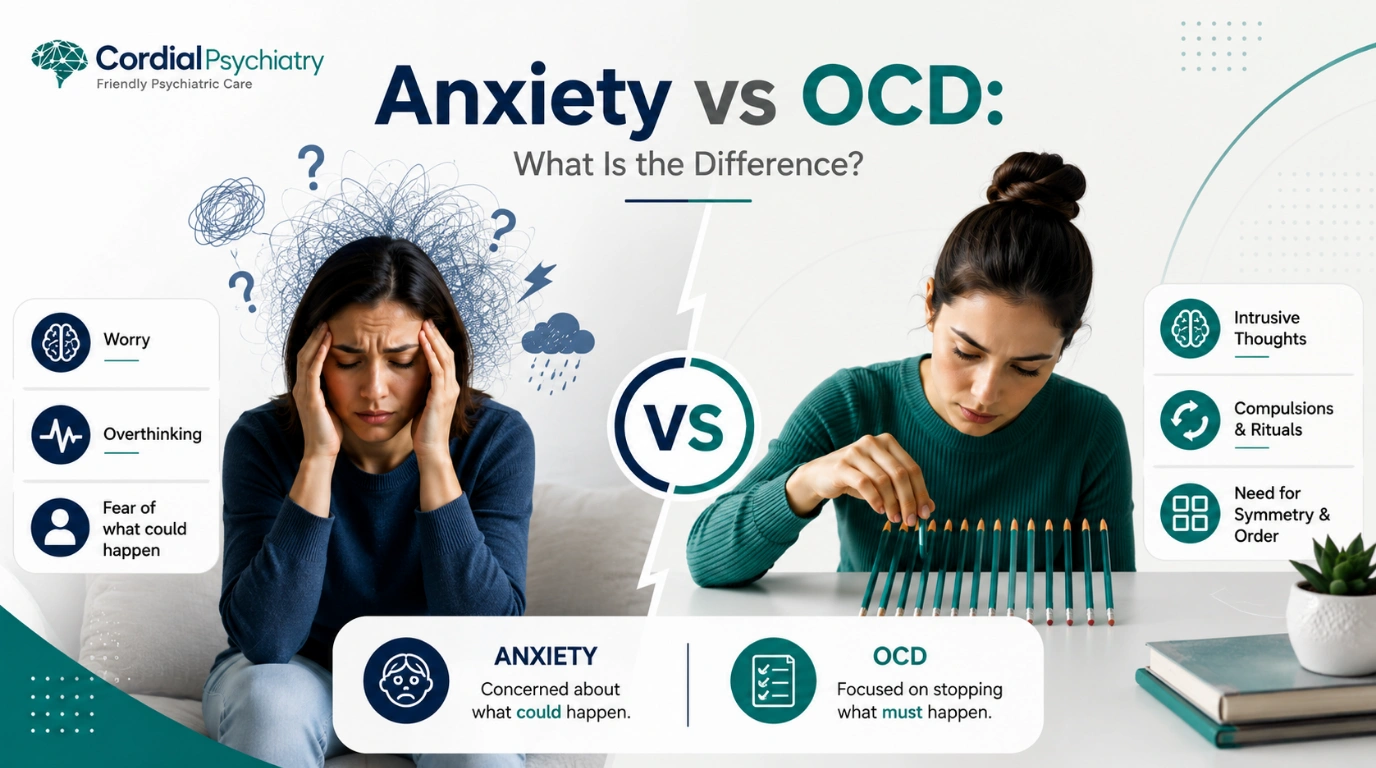
Anxiety vs OCD: What Is the Difference?
Anxiety and obsessive-compulsive disorder (OCD) can both involve fear, worry, distress, and unwanted thoughts. Because they share some symptoms, it is easy to confuse one with the other. However, they are different mental health conditions with different patterns of thoughts, behaviors, and treatment needs.
Understanding anxiety vs OCD can help you recognize when worry may be part of an anxiety disorder and when intrusive thoughts and compulsive behaviors may point toward OCD. A professional evaluation is important because symptoms can overlap, and people can also experience both conditions.
What Is Anxiety?
Anxiety is the body’s natural response to stress, uncertainty, or perceived danger. Everyone experiences anxiety from time to time. For example, you may feel nervous before an interview, worried about an important decision, or tense during a difficult situation.
The concern becomes more significant when fear or worry is excessive, persistent, difficult to control, or begins interfering with everyday life.
Common anxiety symptoms may include:
- Excessive or persistent worry
- Feeling restless or constantly on edge
- Irritability
- Difficulty concentrating
- Trouble sleeping
- Muscle tension
- Rapid heartbeat
- Sweating or trembling
- Shortness of breath
- Avoiding situations that cause fear
There are several types of anxiety disorders, including generalized anxiety disorder, panic disorder, and social anxiety disorder. Each can affect people differently. Cordial Psychiatry’s Anxiety Counseling service provides additional information about anxiety symptoms and treatment options.
What Is OCD?
Obsessive-compulsive disorder is a mental health condition involving obsessions, compulsions, or both.
Obsessions are unwanted and recurring thoughts, images, or urges that cause distress. Compulsions are repetitive behaviors or mental acts that a person feels driven to perform, often in an attempt to reduce anxiety or prevent something feared from happening.
For example, someone with OCD may repeatedly worry that they left a door unlocked. Even after checking it, the doubt may return. They may feel compelled to check the lock again and again to get temporary relief.
Common OCD symptoms include:
- Fear of contamination or germs
- Repeated checking
- Unwanted aggressive or disturbing thoughts
- Fear of causing harm
- Excessive need for order or symmetry
- Repeated counting
- Mental rituals
- Reassurance seeking
- Repeated cleaning or washing
OCD is not simply being organized, cautious, or concerned about cleanliness. The symptoms can become time-consuming, distressing, and disruptive to daily activities. Cordial Psychiatry’s guide on what OCD is, its symptoms, and psychotherapy treatment explains these patterns in greater detail.
Anxiety vs OCD: What Is the Difference?
The main difference between anxiety and OCD is the pattern behind the distress.
With many anxiety disorders, worry tends to focus on real-life concerns or situations. A person may worry about work, finances, health, relationships, social situations, or future events.
With OCD, distress often centers on intrusive thoughts, images, or urges and the need to respond through compulsions or mental rituals.
For example:
Anxiety:
“I am worried that I might fail my upcoming exam.”
OCD:
“I keep thinking that I made a terrible mistake on my exam, even though I checked my answers several times, and I feel compelled to review them again.”
This distinction does not mean every anxious thought is reasonable or every OCD thought is irrational. The important factor is the recurring pattern and how the person responds to the thought.
Difference Between Anxiety and OCD
Understanding the difference between anxiety and OCD becomes easier when you look at the source of the distress, the behavior that follows, and how much the symptoms interfere with life.
| Feature | Anxiety | OCD |
| Main concern | Worry or fear about situations, events, or possible outcomes | Intrusive obsessions and distress about specific fears or possibilities |
| Thoughts | Often focused on real-life concerns | Often repetitive, intrusive, unwanted, or difficult to dismiss |
| Behavioral response | Avoidance, reassurance, planning, or coping behaviors | Compulsions or mental rituals |
| Relief | May improve when the situation changes or reassurance is received | Compulsions may provide temporary relief, but the cycle often returns |
| Daily impact | Can interfere with work, relationships, sleep, and daily activities | Can become highly time-consuming and interfere with daily functioning |
These differences are useful for understanding symptoms, but they are not a substitute for a professional diagnosis.
Anxiety vs OCD: How to Tell the Difference
Many people ask anxiety vs OCD how to tell the difference because both conditions can involve excessive fear and repetitive thinking.
Consider these questions:
1. What are you worried about?
Anxiety often involves concerns about everyday situations, such as health, finances, relationships, work, or social interactions.
OCD may involve intrusive fears that feel unwanted or difficult to control, sometimes involving harm, contamination, mistakes, morality, or uncertainty.
2. What happens after the thought?
With anxiety, someone may try to avoid a situation, seek reassurance, think through possible outcomes, or repeatedly plan for what might happen.
With OCD, the person may perform a compulsion to neutralize the thought or reduce distress.
3. Do you feel driven to perform rituals?
This is an important distinction. OCD can involve compulsions such as checking, washing, counting, arranging, repeating actions, or performing mental rituals.
Not everyone with anxiety performs compulsions, although anxiety can also lead to repetitive reassurance seeking or avoidance.
4. How much time do symptoms consume?
Both anxiety and OCD can interfere with daily life. However, OCD symptoms can become particularly disruptive when obsessions and compulsions take significant time or make it difficult to complete ordinary activities.
5. Can you move on from the thought?
People with anxiety may find it difficult to stop worrying, but OCD often involves a persistent cycle of intrusive thoughts followed by compulsive responses.
The thought may return even after the person has received reassurance or completed a ritual.
Signs of Anxiety vs OCD
Looking at the signs of anxiety vs OCD can help you understand which pattern may better describe your experience.
Signs More Commonly Associated With Anxiety
You may experience:
- Persistent worry about several areas of life
- Fear about future events
- Physical tension
- Restlessness
- Difficulty sleeping
- Panic or intense fear
- Avoidance of stressful situations
- Difficulty controlling worry
Signs More Commonly Associated With OCD
You may experience:
- Repeated unwanted thoughts or images
- Strong distress caused by intrusive thoughts
- Repetitive checking or cleaning
- Mental counting or repeating
- A strong need for certainty
- Reassurance seeking
- Feeling compelled to perform rituals
- Temporary relief after completing a compulsion
- Significant time spent managing obsessions or compulsions
Having one or more of these symptoms does not automatically mean you have a specific disorder. A qualified mental health professional should evaluate the full pattern, duration, severity, and impact of symptoms.
Can You Have Anxiety and OCD at the Same Time?
Yes. A person can experience both an anxiety disorder and OCD.
This is one reason anxiety vs OCD can be difficult to understand based on symptoms alone. Someone may have generalized anxiety and also experience intrusive thoughts and compulsive behaviors associated with OCD.
When conditions overlap, treatment should address the individual’s complete symptom pattern rather than focusing on one symptom in isolation.
A psychiatric evaluation can help determine whether symptoms are related to anxiety, OCD, another condition, or more than one condition.
How Are Anxiety and OCD Treated?
Treatment depends on the diagnosis, symptoms, severity, medical history, and individual needs.
Psychotherapy
Psychotherapy can help people understand thought patterns, manage distress, and develop healthier responses to difficult emotions and thoughts.
Cognitive Behavioral Therapy (CBT) is commonly used for anxiety and several other mental health conditions. You can learn more through Cordial Psychiatry’s complete guide to Cognitive Behavioral Therapy.
For OCD, Exposure and Response Prevention (ERP), a specialized form of CBT, is an important evidence-based approach. It helps people gradually face feared thoughts or situations while learning not to respond with compulsive rituals.
Medication
Medication may be appropriate for some people with anxiety disorders or OCD. A psychiatrist can evaluate symptoms, discuss potential options, monitor response, and make adjustments when needed.
Medication decisions should always be individualized rather than based solely on symptoms found in an online article.
Combined Treatment
Some people benefit from a combination of psychotherapy and medication. The appropriate approach depends on the person’s symptoms and treatment goals.
Cordial Psychiatry provides psychiatric evaluation, psychotherapy, and medication-related care as part of individualized mental health treatment. Its existing content also discusses how therapy and medication can be combined in psychiatric care.
When Should You Seek Professional Help?
Consider speaking with a mental health professional when anxiety, intrusive thoughts, or repetitive behaviors begin affecting your daily life.
Professional support may be especially helpful if you:
- Cannot control persistent worry
- Spend significant time checking, cleaning, or repeating behaviors
- Avoid important activities because of fear
- Have difficulty sleeping because of anxious thoughts
- Experience intrusive thoughts that cause significant distress
- Find that symptoms interfere with work, school, or relationships
- Have tried coping strategies but symptoms continue
You do not need to wait until symptoms become severe before seeking help.
A psychiatrist can evaluate your symptoms and determine whether psychiatric treatment, psychotherapy, medication management, or a combination may be appropriate.
Final Thoughts on Anxiety vs OCD
Understanding anxiety vs OCD starts with recognizing that the conditions can overlap but are not the same. Anxiety commonly involves persistent worry or fear, while OCD is characterized by intrusive obsessions and compulsions that can create a repeating cycle of distress and temporary relief.
Knowing the difference between anxiety and OCD can help you recognize concerning patterns, but self-diagnosis is not enough. If symptoms are persistent or affecting your daily life, a professional evaluation can provide a clearer understanding and appropriate treatment recommendations.
Cordial Psychiatry focuses on personalized psychiatric care based on each person’s symptoms, needs, and goals. Getting the right assessment is an important first step toward managing symptoms and improving overall mental well-being.
Frequently Asked Questions
Is OCD just a severe form of anxiety?
No. OCD and anxiety disorders can share symptoms, but OCD has its own characteristic pattern of obsessions and compulsions. A person can also have both OCD and an anxiety disorder.
What is the biggest difference between anxiety and OCD?
The biggest difference is often the pattern of symptoms. Anxiety commonly involves persistent worry, while OCD involves unwanted obsessions and compulsions or mental rituals performed in response to distress.
Can anxiety cause obsessive thoughts?
Anxiety can involve repetitive or intrusive worry, but having unwanted thoughts does not automatically mean someone has OCD. OCD is typically identified by a broader pattern involving obsessions, compulsions, and significant distress or impairment.
How do I know if I have anxiety or OCD?
Pay attention to recurring thought patterns, behaviors, compulsions, avoidance, and how much symptoms interfere with daily life. A qualified mental health professional can provide an accurate evaluation.
Can you have anxiety and OCD together?
Yes. Some people meet criteria for both conditions. Because symptoms can overlap, professional assessment can help determine the most appropriate diagnosis and treatment approach.
Is OCD treatable?
Yes. OCD can be treated, and evidence-based approaches such as CBT with Exposure and Response Prevention can be effective. Medication may also be considered depending on individual circumstances.
Should I see a psychiatrist for anxiety or OCD?
A psychiatrist can help evaluate symptoms, clarify possible diagnoses, and discuss treatment options such as psychotherapy and medication. Professional guidance is especially important when symptoms interfere with daily functioning.
Can OCD go away without treatment?
Symptoms may change over time, but significant OCD symptoms can persist and interfere with daily life. Seeking professional support can help people understand their symptoms and access appropriate treatment.