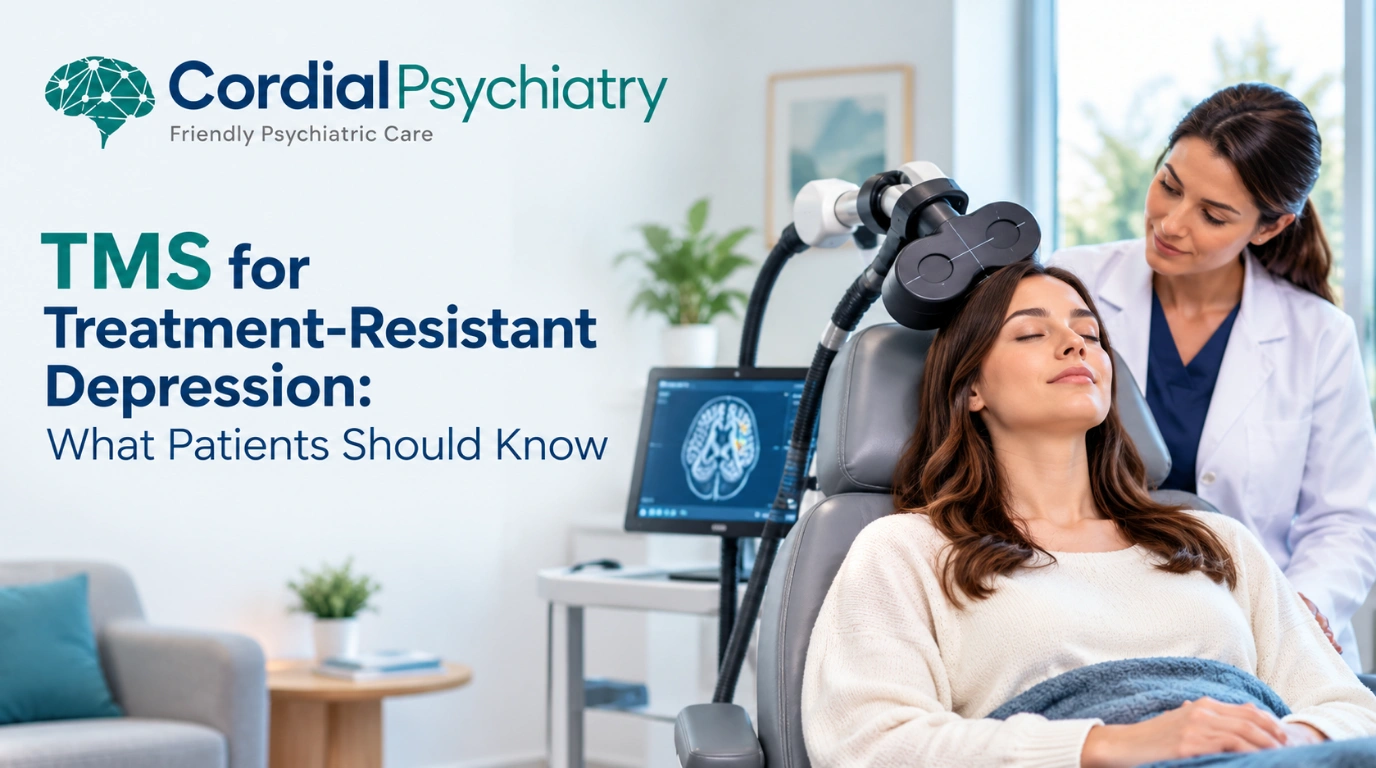
TMS for Treatment-Resistant Depression: What Patients Should Know
Depression can make daily life feel far harder than it once did. You may have tried medication, therapy, or both and still be struggling. When treatment has not brought enough relief, it is understandable to wonder what comes next.
TMS for treatment-resistant depression is one option a psychiatrist may discuss after a careful assessment. TMS, short for transcranial magnetic stimulation, uses magnetic pulses to stimulate brain areas involved in mood. It does not involve surgery, needles, or anesthesia.
Treatment-resistant depression does not mean you have failed or are out of options. It means your current plan has not improved symptoms enough. An evaluation can clarify whether TMS therapy for depression, a medication change, psychotherapy, or combined care is the most appropriate next step.
Quick answer: What is TMS for depression?
TMS is a medically supervised treatment for major depressive disorder. A small electromagnetic coil is placed against the scalp and delivers targeted magnetic pulses to a brain area involved in mood. When standard approaches such as antidepressant medication and psychotherapy have not provided sufficient relief, TMS treatment for depression may be considered.
TMS does not work the same way for every person. A consultation helps determine whether it is safe and appropriate for your history and goals.
What does treatment-resistant depression really mean?
The phrase “treatment-resistant depression” is generally used when a person continues to experience clinically significant depression despite appropriate treatment attempts. It is a clinical signal that the treatment plan deserves another look.
Before recommending TMS, a psychiatric provider should review more than a medication list. This includes symptoms, diagnosis, previous treatments, medication doses and duration, therapy history, sleep, substance use, physical health, stressors, and other mental health conditions. A medication may not have been tried long enough, may have caused difficult side effects, or may not have been the right match. In other cases, the history may support considering repetitive transcranial magnetic stimulation, also called TMS.
How does TMS therapy for depression work?
During TMS therapy, a trained clinician places an electromagnetic coil against a specific area of the scalp. The coil creates magnetic pulses that stimulate nerve cells in a region of the brain associated with mood and depression. You may hear clicking sounds and feel a tapping sensation during treatment.
TMS is non-invasive. Nothing is implanted in the body, and no anesthesia is required. Patients usually remain alert and can speak with the treatment team during the visit.
The science is still being studied, and it is important not to overpromise how TMS works for each individual. The treatment is designed to influence brain circuits involved in depression. It is not electroconvulsive therapy, or ECT, and does not intentionally cause a seizure.
Many people search “does TMS work for depression?” because they want a clear yes-or-no answer. The honest answer is that TMS can help some people with major depression, particularly when other treatments have not helped enough, but no treatment can guarantee a specific result. Your provider should explain potential benefits and limitations in the context of your own care.
Who may be a candidate for TMS?
A psychiatrist may discuss TMS for treatment-resistant depression with adults whose depression has persisted despite previous treatment. It may also be considered for someone who has experienced medication side effects that make ongoing treatment difficult.
You may want to ask about TMS if symptoms continue after medication or therapy, if antidepressants have not brought enough relief, if side effects have been difficult, or if you want to explore a non-invasive option.
Eligibility is not determined by one symptom or one prescription. Your clinician will consider your diagnosis, treatment history, health, medications, and safety factors. Share any history of seizures, bipolar disorder, implanted devices, or metal in or near the head.
What happens during TMS treatment?
The process begins with a consultation. Your provider reviews your symptoms, treatment history, goals, and medical information, then discusses whether TMS is appropriate. If it is, the team determines the treatment location and settings that will be used.
At the first treatment visit, the provider may perform a mapping process to find the correct placement and stimulation level. You sit in a treatment chair, wear ear protection, and the coil is positioned against your head. The sensation is often described as tapping on the scalp.
TMS is delivered as a series of outpatient appointments over several weeks. The exact schedule, session length, and number of sessions depend on the protocol your clinician recommends. Your team should explain the plan and track symptoms throughout care.
Because no anesthesia is used, many people return to usual activities after a session. Follow your clinician’s advice, especially after the first appointment.
TMS side effects and safety considerations
TMS is generally well tolerated, but it is still a medical treatment. Common side effects can include scalp discomfort, headache, tingling, facial muscle twitching, or temporary lightheadedness. These effects are often mild and may improve over time. The provider may be able to adjust settings to improve comfort.
Serious side effects are uncommon, but they must be discussed. A seizure is a rare risk. TMS can also be a concern for people with certain metal or implanted devices. People with bipolar disorder require careful evaluation because mania can be a risk with depression treatments.
Tell your provider about all medications, supplements, medical conditions, implanted devices, pregnancy, neurological history, and any previous TMS treatment. Do not stop antidepressants or change your medication without speaking to the clinician who prescribes them.
TMS, medication management, and psychotherapy
You do not always have to choose one approach. A depression treatment plan may include TMS alongside medication management, psychotherapy, or both. Medication can reduce symptoms, while therapy can help people develop coping skills and address patterns that affect daily life.
For some, TMS becomes an additional treatment after medication and therapy have not provided enough relief. For others, a medication adjustment, more consistent therapy, or a different approach may be more appropriate. The goal is care that fits your diagnosis, history, safety needs, and goals.
Questions to ask at a TMS consultation
Consider asking:
- Is TMS appropriate for my diagnosis and treatment history?
- What treatment protocol do you recommend, and why?
- How many sessions might I need, and how often are they scheduled?
- What might the first appointment feel like?
- Which side effects should I report right away?
- Can I continue medication and therapy during TMS?
- How will we measure whether the treatment is helping?
- What insurance requirements or prior authorization steps apply to me?
- What are my options if TMS is not the right fit?
A trustworthy provider will discuss limitations as well as potential benefits, and give you space to decide.
Frequently asked questions about TMS for depression
Is TMS painful?
TMS is not usually described as painful, but some people notice scalp discomfort, tapping, or a mild headache. Tell the treatment team if you feel uncomfortable. Settings may sometimes be adjusted to improve tolerability.
How soon will I notice results from TMS?
Response varies. Some people notice gradual changes after several sessions, while others may not respond. Your provider should monitor symptoms rather than promise a timeline.
Can I work or drive after a TMS appointment?
Many people can return to normal activities after treatment. Your clinician can give guidance based on your medical history and how you feel after sessions.
Is TMS covered by insurance?
Coverage depends on your plan. Insurance companies may require documentation of previous treatment. Ask the office to verify benefits and explain any prior authorization process.
Is TMS therapy available near Yonkers and Westchester County?
For people looking for TMS therapy in New York, Cordial Psychiatry offers TMS services in Yonkers. A consultation is the best way to find out whether this approach is appropriate for you and what treatment planning may involve.
Explore your next step with Cordial Psychiatry
Living with depression that has not improved enough with previous care can be discouraging. It does not mean there is nothing else to try. At Cordial Psychiatry, patients can discuss TMS therapy in Yonkers, psychiatric services, medication management, and psychotherapy as part of an individualized care plan.
If you are searching for TMS for treatment-resistant depression or TMS treatment in New York, schedule a consultation to review your symptoms, treatment history, and options with a qualified mental health provider.
This article is for educational purposes and is not a substitute for personal medical advice. If you are in immediate danger, thinking about harming yourself, or experiencing a mental health emergency, call or text 988 in the United States or go to the nearest emergency department.